
Outdoor
Pool Feature Walls & Water Features
Pool environments destroy the wrong material in a season. Here's what holds up, and where the limits actually are.
Pools are the most demanding thing Miami Stone Veneer Specialists supplies into, and the reason isn't the water. It's the cycling — wet, dry, wet, dry, with chlorine or salt concentrating a little more each time the surface evaporates.
Three zones, three answers
- Below the waterline. Not our product. Fully submerged surfaces are tile or plaster. Anyone who tells you adhered veneer belongs down there is going to cost you a pool.
- The splash zone. Waterline, spillways, raised beam faces. Our stone works here and needs sealing on a shorter cycle — three to four years rather than seven.
- Surrounds and feature walls. Standard exterior specification. This is where stone does its best work anyway, because it's vertical and people see it at eye level.
Why pale stone wins here too
Same reason as waterfront elevations. Evaporating pool water leaves mineral deposits, and on a dark stacked stone that white bloom shows within a couple of months. Homeowners then attack it with acid wash or a pressure washer, which is how a good wall becomes a ruined one.
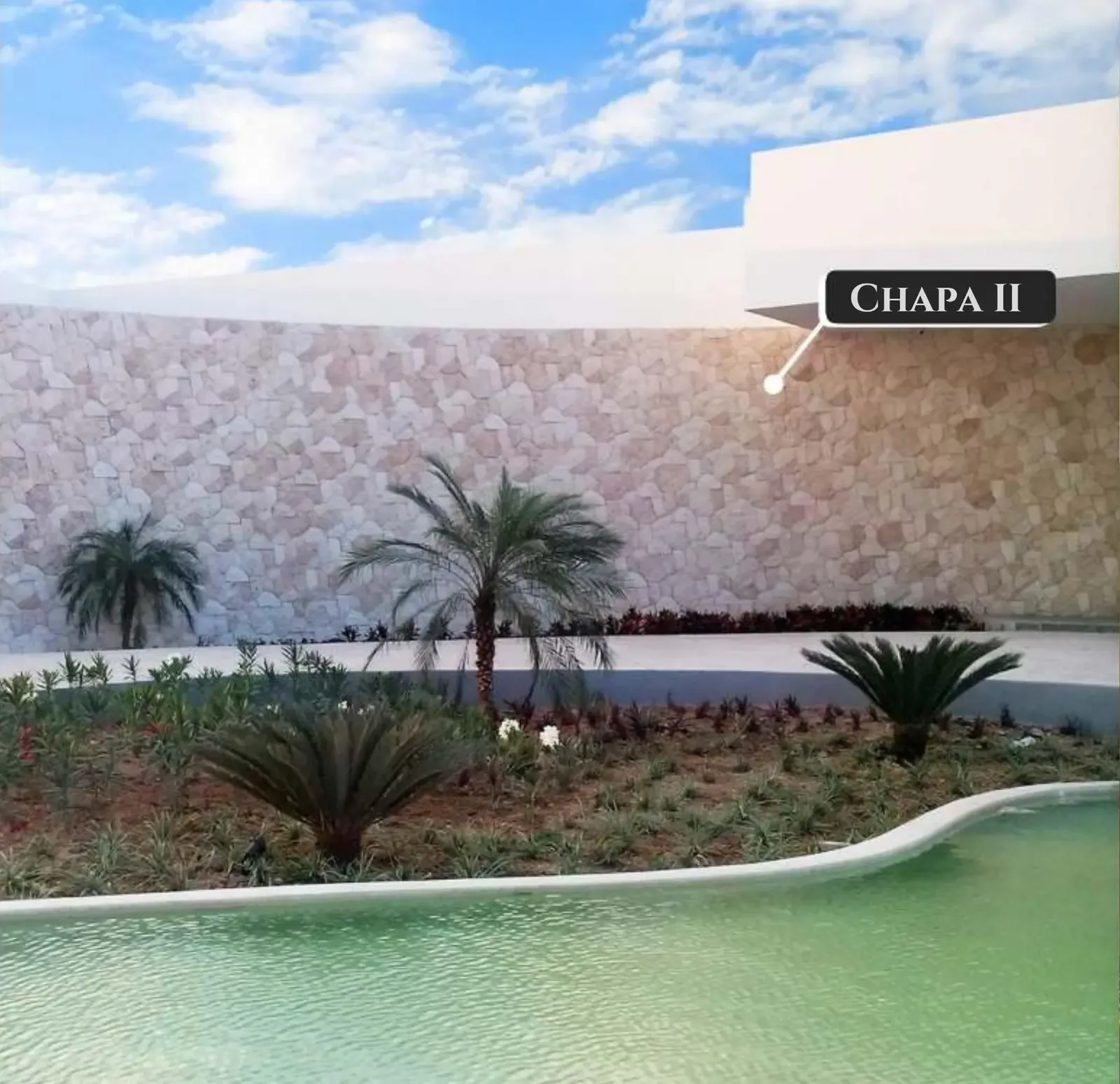
On a pale, shell-flecked face it's effectively invisible. Our Coastal range exists for this. Chapa is the other favourite — flagstone reads as natural around water in a way coursed stone doesn't.
The detail everyone forgets
Where the stone meets the deck. If the veneer runs down to the deck surface with no gap, water wicks up behind it by capillary action and stays there. Leave a small reveal and a weep at the base so it can drain.
It's a five-minute decision at install and it's the difference between a feature wall that's fine in fifteen years and one with efflorescence streaking down it in three.
What it costs
Material $11 to $18 per square foot. A typical raised beam and feature wall package on a residential pool runs 150 to 400 square feet. Budget sealer separately and plan on re-doing it — it's cheap and it's the only maintenance this really needs.
Products specified for this
Stacked Stone
The most-specified profile we sell. Long, low courses that read as a clean horizontal band — the look behind most modern Miami feature walls and outdoor kitchen islands.
View details →Mediterranean Stone
The Mediterranean look South Florida keeps coming back to. Long, low courses in warm limestone tones, with a radiused piece for columns and curved walls.
View details →Chapa
Random flagstone without the layout headache — Chapa ships as a modular 7-piece sheet that repeats cleanly. Thin brick and four-size Roman opus sit alongside it.
View details →Coastal Stone
Made for waterfront elevations. Pale, shell-flecked faces plus a cool riven slate, all rated for direct salt-air exposure with a penetrating sealer.
View details →Related applications
Exterior Wall Cladding
The biggest surface on the job and the one that has to survive Miami weather. Here's what we stock for exterior elevations and how it's specified.
View details →Outdoor Kitchens
Summer kitchens run year-round here. Concrete stone over block takes direct grill heat and afternoon storms without complaint.
View details →Feature Walls
When the wall is the point. Deep-relief panels, lattice screens, and large-format stone specified for maximum effect.
View details →Worth reading first
Stone Veneer for Coastal Homes
Within a mile of the water, salt drives the whole specification — material, mortar, sealer, and maintenance interval.
View details →Stone Veneer Maintenance
Ninety percent of stone failures we see trace back to one of four maintenance mistakes. All four are avoidable.
View details →How to Clean Manufactured Stone
Pressure washers and acid wash are the two fastest ways to destroy a good stone wall. Here's what to use instead.
View details →Common questions
Can stone veneer go below the waterline? +
Not adhered veneer, no. Below the waterline is tile or plaster territory — it's a fully submerged, chemically aggressive environment. Our product works at and above the waterline: raised beams, spillways, feature walls, and the surrounds.
Chlorine or saltwater — does it matter which? +
Saltwater is harder on everything, including the pool equipment. For stone the difference is mostly cosmetic: salt leaves visible mineral bloom on dark faces. Pale stone and a good sealer handle both.
What about the constant splash zone? +
That's the harshest part of the whole installation — wet, dry, wet, dry, all day, with chemicals concentrating each time it evaporates. Seal it, and re-seal it more often than the rest of the wall. Every three to four years rather than seven.
Will it get too hot to touch? +
On a deck, potentially — same as any hard surface in Florida sun. Pale colours run noticeably cooler than dark ones. For barefoot areas most people use a dedicated pool deck paver and keep the stone for the vertical surfaces, which is what it's best at anyway.
Talk to us about pool features
Samples, take-offs, and pricing for projects across Miami and South Florida.