
Outdoor
Outdoor Kitchens & BBQ Islands
Summer kitchens run year-round here. Concrete stone over block takes direct grill heat and afternoon storms without complaint.
An outdoor kitchen in Miami isn't a summer thing, it's a year-round thing, and it gets used hard. Miami Stone Veneer Specialists supplies a lot of stone into these — and almost all the problems come from what's underneath it rather than the stone itself.
Build the island right or nothing else matters
Outdoor kitchen islands get built three ways. Concrete block is the best — heavy, stable, non-combustible, and it takes veneer directly on a scratch coat. Steel stud with cement board is the common alternative and it's fine.
Timber framing is the one that fails. In this climate, framed with wood and wrapped in stone, you have built a warm, damp, dark box with a food supply. Termites find it. So does rot. We've seen islands that looked perfect from the outside collapse when someone leaned on the countertop.
Seal before you cook
Sealer goes on before the grill is ever lit, not after the first cookout. Grease aerosolises, lands on the stone, and soaks into an unsealed face permanently. There's no recovering it — you replace the stone.
Use a penetrating sealer rated for food-contact-adjacent surfaces, and re-do it every three or four years given the exposure. It's a cheap afternoon.
Profile and scale
Islands are small surfaces, and that changes what looks right. A 36-inch high island clad in a face with 9-inch coursing shows about three courses — the stone reads as oversized and the island looks squat.
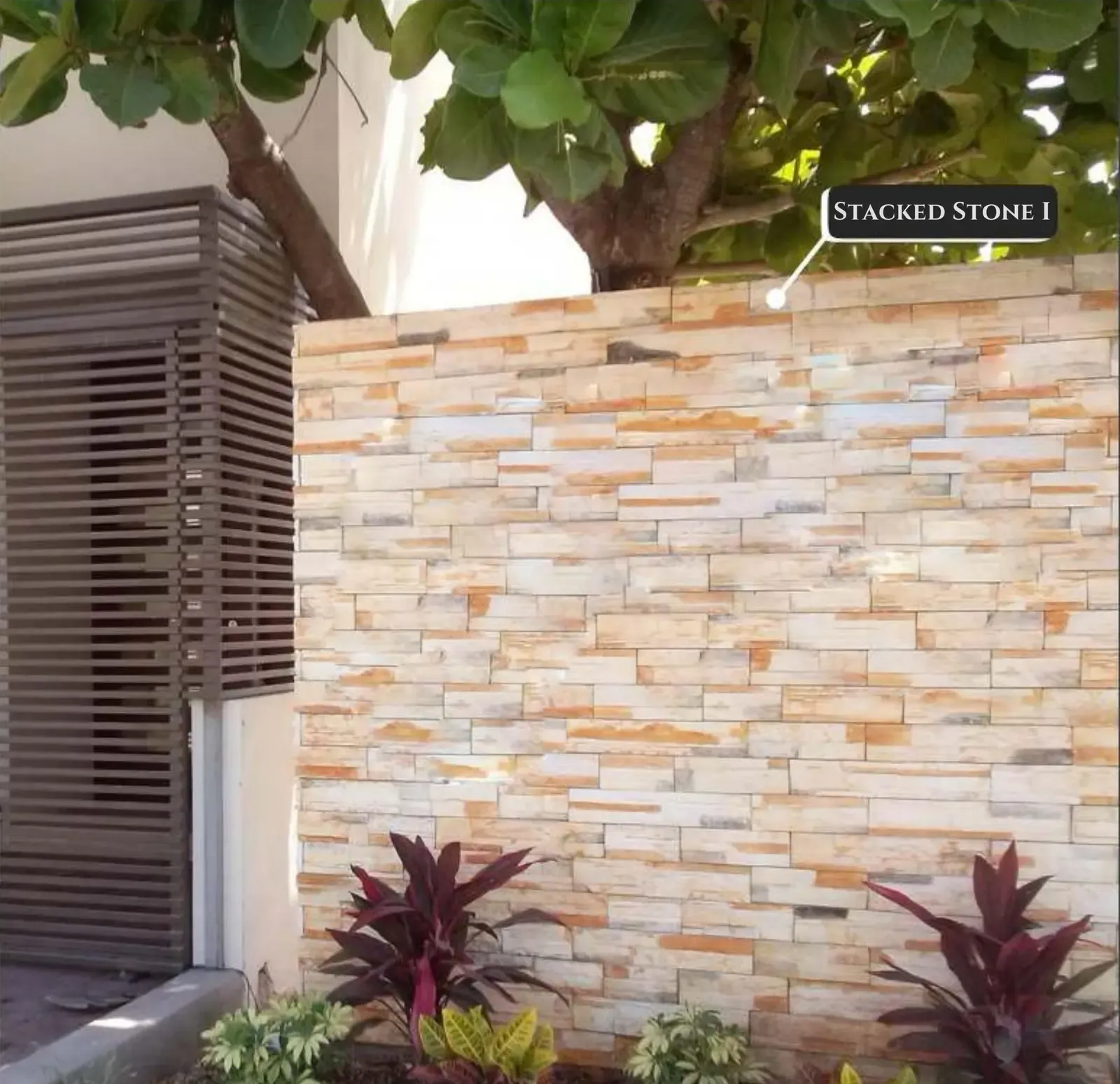
Slim profiles solve it. Stacked Stone I at 3¾ inches gives you nine or ten courses on the same island and the proportion looks considered. It also has fewer horizontal ledges for grease and rain to collect on, which matters more than it sounds.
What it costs
A typical L-shaped island runs 60 to 110 square feet of stone. Material $700 to $1,900. If there's a bar front and a back wall behind the grill, roughly double it. Send a sketch with dimensions and we'll work it out properly.
Products specified for this
Stacked Stone
The most-specified profile we sell. Long, low courses that read as a clean horizontal band — the look behind most modern Miami feature walls and outdoor kitchen islands.
View details →Rustic Stone
Deep relief and heavy texture for elevations that need weight. Six-size ashlar mixes through to 24-inch quarried panels.
View details →Chapa
Random flagstone without the layout headache — Chapa ships as a modular 7-piece sheet that repeats cleanly. Thin brick and four-size Roman opus sit alongside it.
View details →Coastal Stone
Made for waterfront elevations. Pale, shell-flecked faces plus a cool riven slate, all rated for direct salt-air exposure with a penetrating sealer.
View details →Related applications
Pool Features
Pool environments destroy the wrong material in a season. These are the faces that hold up to continuous chlorine and salt exposure.
View details →Fireplaces
A fireplace surround is the one wall everyone stares at. Non-combustible concrete body, and formats that mitre cleanly at the returns.
View details →Feature Walls
When the wall is the point. Deep-relief panels, lattice screens, and large-format stone specified for maximum effect.
View details →Worth reading first
Stone Veneer Cost in Miami
Material, labour, prep, and sealer — broken out separately so you can see where the money actually goes.
View details →Stone Veneer Maintenance
Ninety percent of stone failures we see trace back to one of four maintenance mistakes. All four are avoidable.
View details →How to Clean Manufactured Stone
Pressure washers and acid wash are the two fastest ways to destroy a good stone wall. Here's what to use instead.
View details →Common questions
Can stone go right up against a built-in grill? +
With the manufacturer's clearances respected, yes — our stone is non-combustible concrete. The thing that fails near a grill isn't the stone, it's the substrate and the adhesive if someone used the wrong ones. Build the island in block or steel stud with cement board, not timber.
What stops grease staining? +
Sealer, applied before the grill is ever lit. An unsealed porous face next to a grill will absorb grease within weeks and it does not come out. This is the single most common outdoor kitchen regret we hear about.
Which profile suits an island? +
Something slim. Stacked Stone I at 3¾ inches wraps a 36-inch island without the coursing looking oversized. Deep rustic faces on a small island look lumpy and give grease more ledges to sit on.
Does it survive being outside year-round here? +
Easily. It's the same product that goes on facades. Summer storms, humidity, and UV are non-issues. The grill is a harsher neighbour than the weather.
Talk to us about outdoor kitchens
Samples, take-offs, and pricing for projects across Miami and South Florida.